
“That Italian Artist That Makes Clothes” - Elsa Schiaparelli
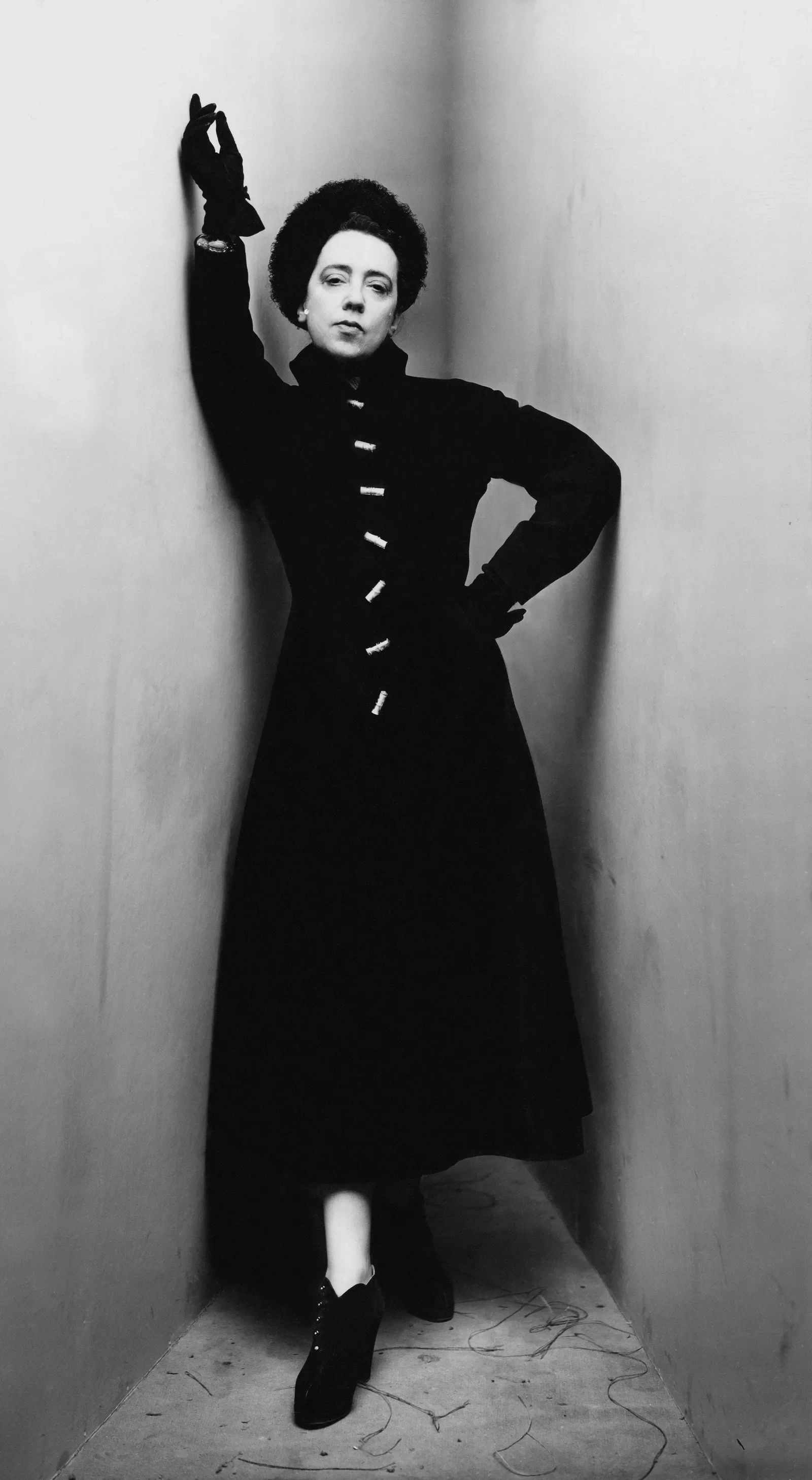
Schiaparelli is one of those brands that is (in my opinion) at the peak of the runway.
Schiaparelli wasn’t created in 2012, it was revived. There was a 60 year gap between runway shows, 1954 to 2014. And behind the Schiaparelli name, behind the impeccable runways today, was a woman, who was incredibly creative - Elsa Schiaparelli.
Schiaparelli was entirely self-directed, she knew none of the typical dressmaking traditions, and wasn’t held back by an already established understanding of fashion. That quote above is from her rival Coco Chanel, who simply thought of her as an ‘artist’.
Born in Rome in 1890, Schiaparelli was a daughter of an aristocratic family. Studying philosophy, Schiaparelli published a book of poetry in 1911, titled Arethusa. (Apparently her family were so distraught by the ‘passion’ in the book that she was sent to a convent in Switzerland for a few months.)
In 1913, Schiaparelli goes to London to work as a nanny and avoid her parents finding wealthy men for her to marry. On the way there, she stops off at Paris, and as soon as she steps foots on that Parisian ground, she instantly knew that she wanted to spend the rest of her life there. According to her biography, she said “This is the place where I am going to live.”.
A year later Schaparelli visits a lecture on theosophy (a religious movement combining elements of Western and Eastern religions with spirituality), presented by Willem de Wendt (one of his many aliases). Apparently, by the end of the lecture, Schiaparelli was so smitten by Wendt that she was unable to get up from her seat and was offered to meet the lecturer afterwards. By the next morning, they were engaged, much to her parents disgust. By the time her parents arrived in London to stop the marriage, they were already wed on the 21st of July, 1914. From there, Wendt took his interest in theosophy to the paranormal, offering palm readings and monthly astrological forecasts in his own magazine. By July 1915, Wendt was arrested, sentenced to 6 weeks in prison and deported for fortune telling, which was illegal at the time. Him and Schiaparelli left England for Bordeaux in France, avoiding Paris due to WWI, that had only just begun.
Three and half years later, the couple move to New York via the SS Chicago. Wendt continues his fortune telling and occult work (which was also illegal in the US as well), constantly moving in and out of New York to avoid persecution by the FBI and the BOI. By 1919, Schiaparelli was disillusioned by her husband’s career, viewing him as a fraud, a cheater and an unpredictable partner. At this same time, Schiaparelli discovered she was pregnant and gave birth to her daughter Maria Luisa Yvonne Radha (nicknamed Gogo) on the 15th of June, 1920. Shortly after, Schiaparelli and Wendt decided it would be best to split, and Schiaparelli was now a single mother to a newborn, living off the ‘pocket money’ given to her by her parents. In order to make ends meet, Schiaparelli relied on her close friend Gabrielle Buffet-Picabia, wife of Surrealist artist Francis Picabia, to both provide her with work and take care of Gogo. Throughout her friendship with Picabia, Schiaparelli engaged with prominent surrealist artists at the time, including Marcel Duchamp and Man Ray.
“She slapped Paris. She smacked it. She tortured it. She bewitched it. And it fell madly in love with her.”
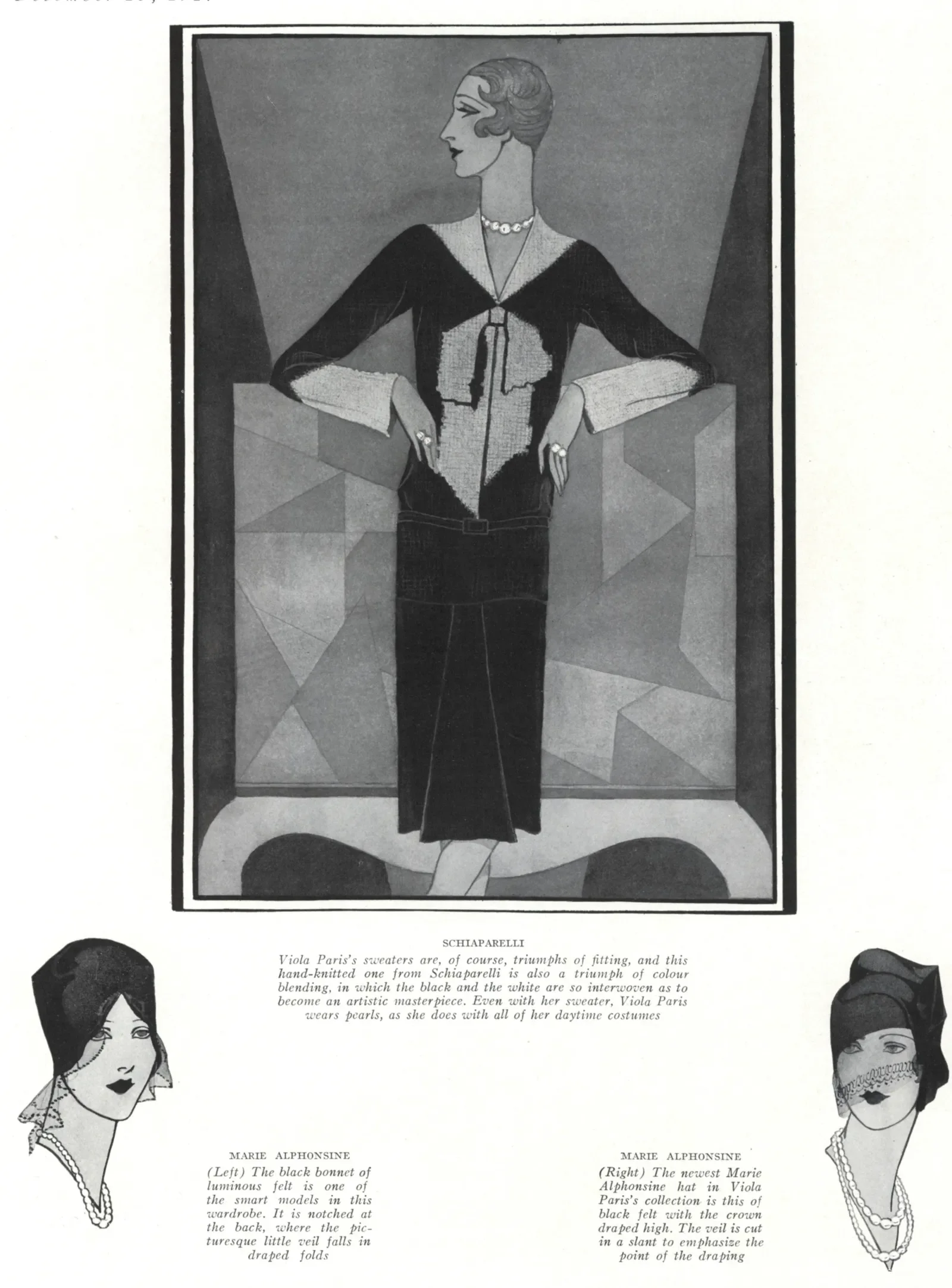
By 1922, Schiaparelli moved from New York to Paris. This trip was a major turning point in her life, as stated in her autobiography “If I have become what I am, I owe it to two distinct things - to poverty and Paris. Poverty forced me to work and Paris gave me a liking for it.”. Again through Picabia, Schiaparelli met French couturier Paul Poiret, who she later referred to as “a generous mentor and dear friend”. From there, she decided to design her own clothing, often draping the fabric on herself as a model and relying on her own artistic impulses. She started making clothing for herself and her inner circle, based off what Schiaparelli thought was missing in the market. Most of the clothing available at the time was simple sportswear, pioneered by designers like Chanel. However, Schiaparelli’s own curiousity brought her to an Armenian knitter named Aroosiag Mikaëlian, who created sweaters using the ‘Armenian stitch’, which utilised two threads. From this chance encounter, Schiaparelli created a few sketches and her first collection of knitwear was created. Featuring ‘trompe l'oeil’ designs, a technique that deceives the eye into thinking a 2D image is actually 3D. One design, a black sweater with a white bow knitted into the front was featured in Vogue in 1927, causing her business - Maison Schiaparelli - to take off. These knitwear designs were ordered by prominent American buyers, including Anita Loos (author of Gentlemen Prefer Blondes) and a buyer from Strauss in New York, who wanted 40 jumpers and skirts delivered in two weeks.
Circling back to Wendt, he and Schiaparelli divorced in 1924 and he was murdered in 1928, with his killer never identified.
Knitwear expanded to bathing suits, ski-wear expanded to linen dresses and evening wear. In 1935, Maison Schiaparelli took up a 98-room salon at the Hôtel de Fontpertuis. Schiaparelli understood house codes, retailing and branding before it was a well-studied phenomenon, initially choosing an icy blue as her brand colour in 1932 and then switching to “Shocking Pink” in 1937 after she created a perfume of the same name (which you can read more about here). She knew that perfume was her cash-cow and her knitwear was her hero product, creating reasons for customers to look up to the brand, come back and keep buying.
“Madame Schiaparelli is the one to whom the word ‘genius’ is applied most often.”
Throughout this time, Schiaparelli was somewhat of an absent mother to Gogo. From a young age, Gogo battled with infantile paralysis from Polio, which meant that she spent most of her early life in hospitals, undergoing treatment and in the care of specialists. Often Gogo and Schiaparelli were in completely different countries and primarily reunited in the 1940s once Gogo was married and starting a family of her own.
By all accounts, Schiaparelli was a great company to work for. She paid very good wages (even during the Depression), gave each employee three weeks of paid holiday leave (before it was even required by law) and kept two beds free at St Joseph Hospital for any employee to use (both current and former). She sent gifts to employees and even helped some raise their children, creating a team of incredibly loyal workers who would even turn down offers from Chanel and Balenciaga to keep working for Schiaparelli. By 1934, Maison Schiaparelli had four hundred employees, creating up to 8 thousand garments per year.
In her own right, Schiaparelli was a celebrity, she was paid to wear and be photographed in certain items, and everyone wanted to be around her and be invited to her iconic parties. There’s this story that, at a costume ball at 1939, Chanel came dressed as herself and Schiaparelli came dressed as a surrealist oak tree (iconic). Chanel apparently ‘accidentally’ steered Schiaparelli into a bunch of lit candles, setting her costume on fire. But Schiaparelli didn’t mind, and went on like nothing happened.
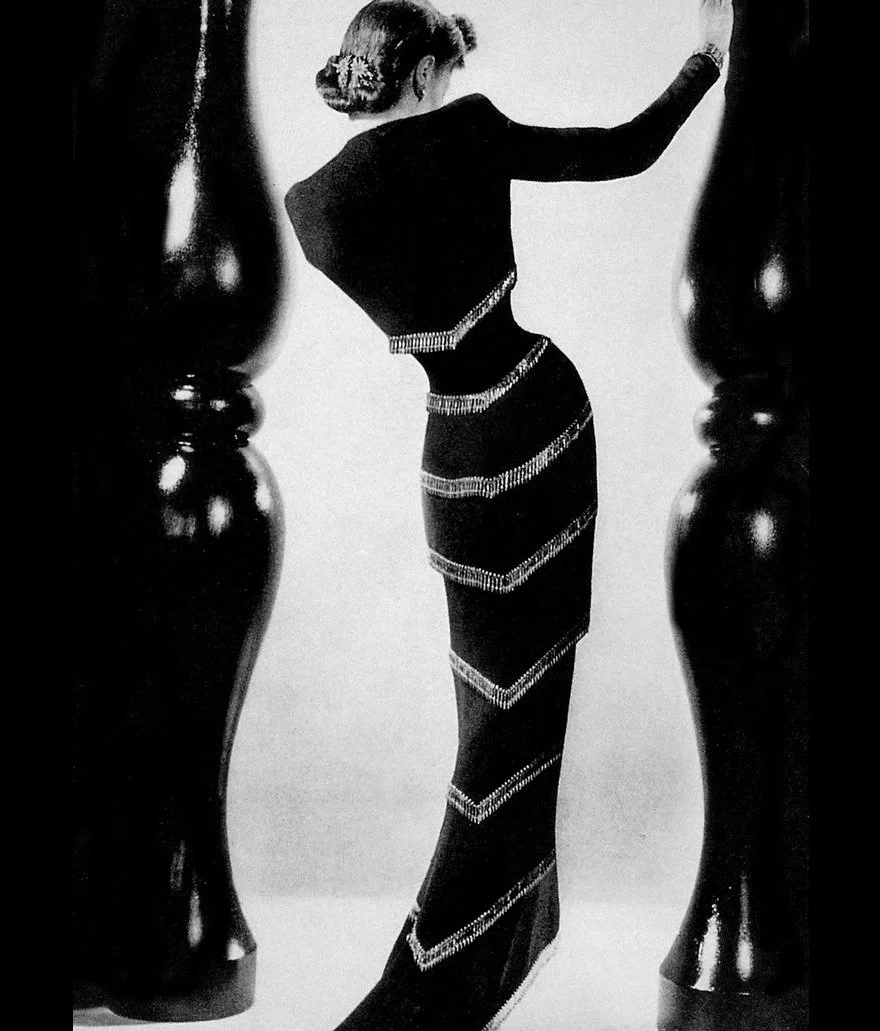
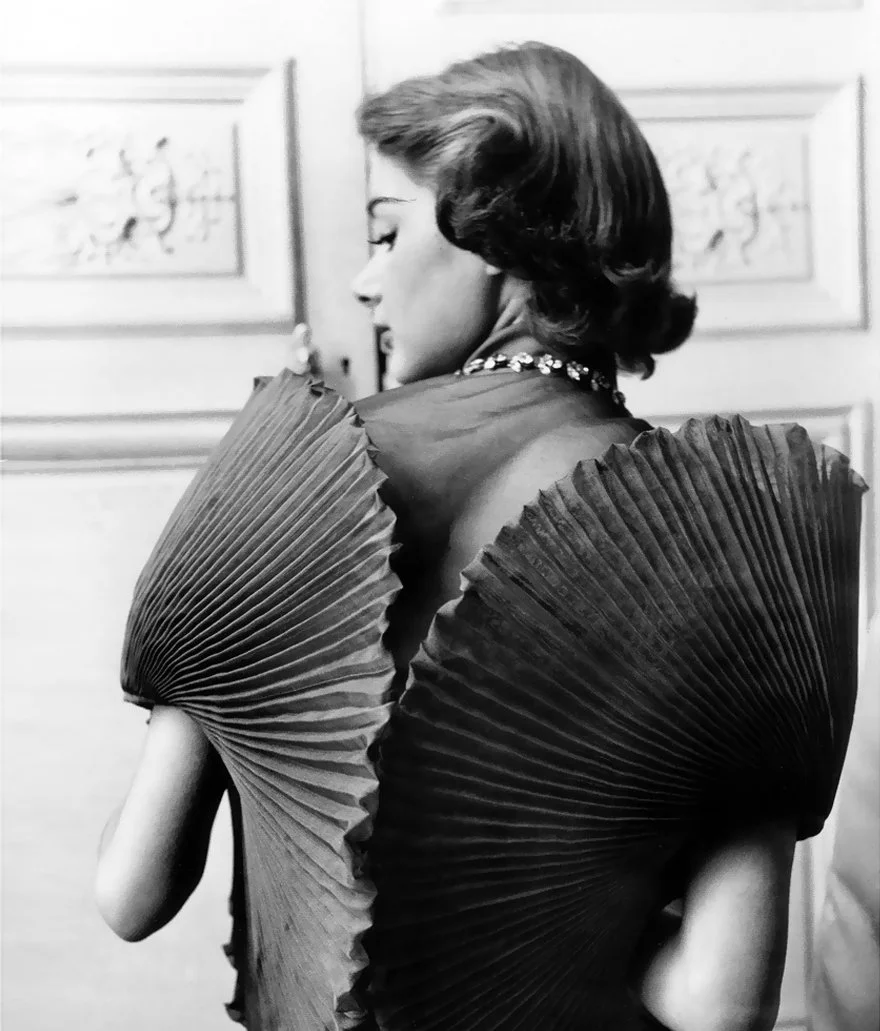
However, everything changed when France declared war on Germany in 1939. Even before the outbreak of the war, Schiaparelli outwardly stated her disdain for Mussolini, joining anti-fascist groups and being openly political in her views. Her mansion in Paris was next to the Belgian Embassy, and she opened her home to serve hot coffee and bread to those in need and provide shelter and rest for American and British officers. In 1940, Mussolini aligned himself with Hitler and as the most famous designer in Paris, Schiaparelli needed to fight back. She took a year long trip across the US, conducting lectures, creating charity events and selling capsule collections to raise money for the Red Cross and the US Quakers. She arrived back in Paris in 1941 with thousands of dollars and medicine smuggled in for the children back in the non-occupied areas of France. When she returned to her business, they were relying on ready-to-buy items; fragrance, soaps, lingerie; something that kept Maison Schiaparelli running financially.
“Practically every single time that Schiaparelli buys a railway ticket, there are fruitful consequences for this world of ours.”
However, in 1941 Schiaparelli was investigated for espionage due to her business having connections in America and Britain. Gossip stories were run about her past and previous partners and eventually her branch in London went bankrupt. She then traveled to the US to set up an office in New York, and was kept in exile to avoid becoming a ‘nazi-sympathiser’ or nazi-spy’. She remained in the US until Germany surrendered in 1945, when she returned back to Paris via the SS Mariposa. Despite all the investigation, Schiaparelli always aligned herself with the allies and actively fought against the fascist rise in WW2 (unlike Chanel).
She arrived back to her boutique and found queues of soldiers buying perfumes and accessories to bring home to their wives and girlfriends. However, the couture side of the brand was failing. Dior’s ‘New Look’ was growing, and Schiaparelli’s style was slowly falling out of fashion. Customers simply moved onto a different style. She fell into debt and could no longer keep her business afloat purely on perfume sales. Maison Schiaparelli closed its doors in 1954.
After her business closed, there’s not much about Schiaparelli’s life. She paid off all her business debts and spent time with her daughter and grandchildren. She passed away in 1973 from natural causes in northern France, at the age of 83.
Schiaparelli - the brand we know today - was the perfume side of the business, opened as Elsa Schiaparelli SAS in 1957 to hold perfume licenses. It was acquirred in 2007 by an Italian businessman and transferred into a fashion house in 2014. After being nominated as a member of the Chambre Syndicale de la Haute Couture, it presented it’s first collection in Paris. By 2018, Daniel Roseberry became creative director, developing Schiaparelli into the heritage house it is today.
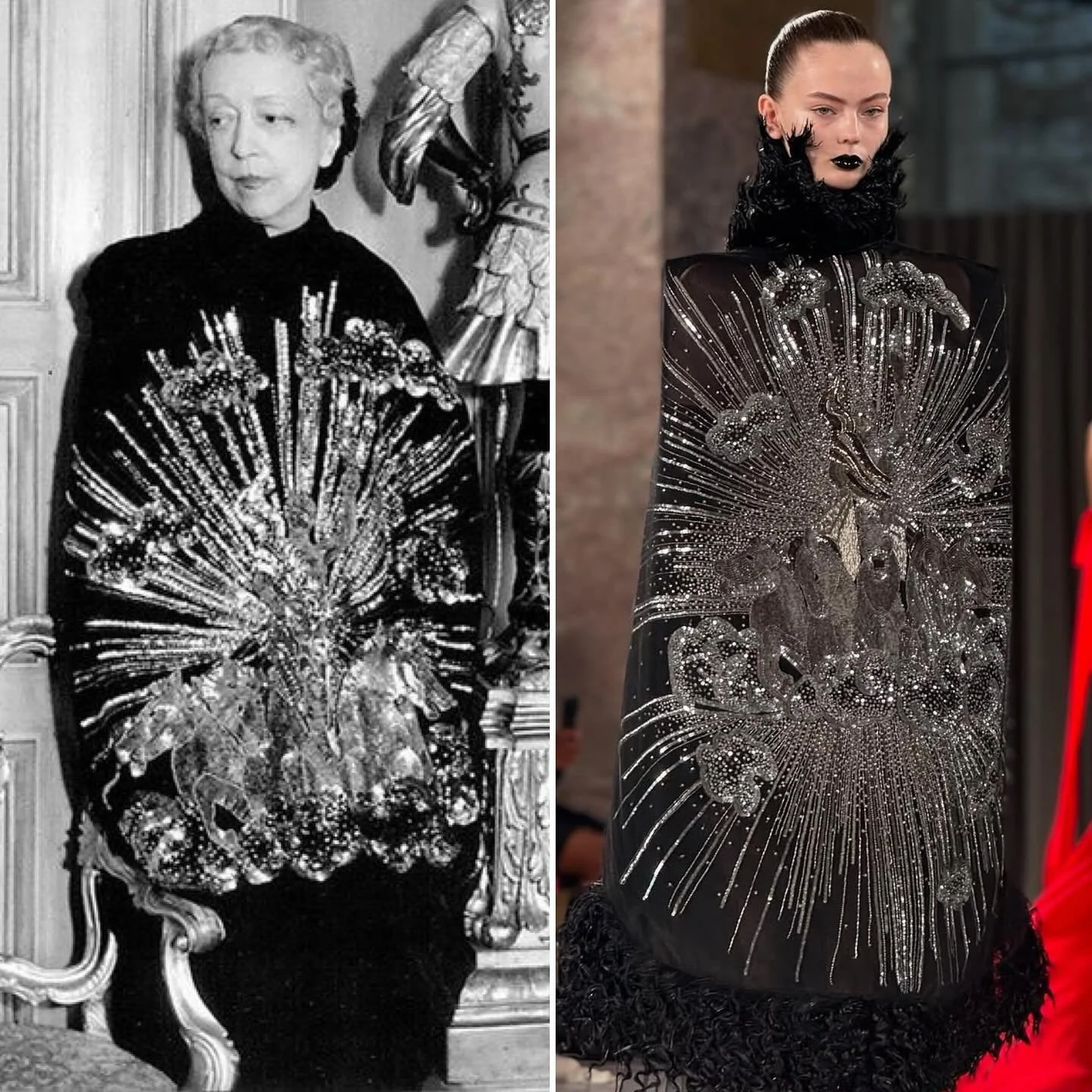
The ‘Apollo Cape’ - 1938 to 2022
Elsa Schiaparelli was a visionary. She was one of the first to develop the wrap dress, clothing with visible zippers as design features and a swimsuit with an incorporated bra in 1930. Her designs combined fashion and art, often using buttons modelled after candlesticks, playing cards and crowns. She designed costumes for Zsa Zsa Gabor in Moulin Rouge (1952) and Mae West in Ever Day’s a Holiday (1937). She collaborated with jewellers and surrealist artists to create pieces that looked like bugs crawling on the wearers skin, had optical illusions embroidered or padding to look skeletal (honourable mention of the famous Lobster Dress, a collaboration between Schiaparelli and Salvador Dali.
It’s unfortunate that (especially compared to Chanel), Schiaparelli has been largely forgotten by wider society. I don’t think there would ever be a designer like her again. I’m glad the Schiaparelli has come back in the way that it has, with Roseberry providing such care to pay homage to the absolute incredible work of a visionary like Schiaparelli.